Herald Reference
The Constitutional System of the Republic of Zandoria
A reference guide to Zandoria's federal constitution: its four regions, bicameral Federal Assembly, ceremonial presidency, Federal Court, citizenship tiers, electoral system, and the two live constitutional questions — the Suffrage Question and the Youth Charter — that will shape the March 2027 general election.
Filed 27 May 2026Constitutional Reference Editor
Overview
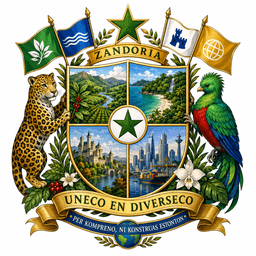
The Republic of Zandoria is a parliamentary federation of four regions, governed under a founding charter whose motto — Uneco en Diverseco, 'Unity in Diversity' — captures the central tension the system is designed to manage: a single federal polity composed of communities whose languages, economies, and political cultures differ substantially. The federal capital, Meridian, is the seat of the Federal Assembly, the Federal Court, and the Federal Translation Centre. All three institutions operate in Esperanto, the Republic's federal language.
Zandoria's constitutional design is distinguished by two features that set it apart from older federal models: citizen-initiated consultative referendums, which any combination of founding and virtual citizens may trigger with fifty thousand verified signatures, and statutory online voting backed by paper verification, which extends the franchise to diaspora citizens worldwide. Both mechanisms flow directly from the founding charter and are administered by the Federal Electoral Commission under the direction of Director Olena Petrova.
The Constitutional Frame
The Republic comprises four regions: Tierra Verde, Costa Mar, Nord Europa, and Oriente Moderno. Each region has its own capital — San Vicente, Puerto Azul, Bratislava-Nova, and Nueva Singapur respectively — and each maintains a working language distinct from federal Esperanto. Tierra Verde operates in Spanish; Costa Mar in English alongside regional creoles; Nord Europa in several Scandinavian languages and Slovak-derived dialects; and Oriente Moderno in a blend of east-Asian languages, Arabic, and Hindi. The Federal Translation Centre, headquartered in Meridian with twelve overseas annexes, underpins the Republic's commitment to linguistic accessibility across all official functions.
The Republic has no state religion and no established military. Its official currency is the Zandorian florin (symbol ₣), informally called 'the zandor,' pegged one-to-one with the euro since the Federation's founding and maintained by the Federal Treasury under Minister Marcus Eklund. Both the florin and the euro are legal tender throughout the Republic; the peg is not under political review.
Separation of powers runs along three axes. The legislature is bicameral: the Federal Assembly (lower house) and the Federal Council (upper house). The executive is headed by the President of the Republic as head of state and the Prime Minister as head of government. The judiciary is anchored by the Federal Court of Zandoria, which interprets the Federal Charter. Each branch is constitutionally distinct; the Federal Council provides a further check through inter-regional review of legislation.
The Federal Assembly
The Federal Assembly holds one hundred seats, elected by closed-list proportional representation within each region. Seat allocation reflects the founding population of each region: Tierra Verde returns twenty-two members, Costa Mar eighteen, Nord Europa forty, and Oriente Moderno twenty. The Assembly serves a four-year term; the current term concludes with the general election scheduled for Thursday, 11 March 2027.
The Prime Minister is chosen by the Assembly from the largest party or coalition able to command a majority. The current Prime Minister, Aleksandra Doric of the Partio de Unueco, leads a governing coalition that includes Federacia Renovigo as junior partner. The Speaker of the Federal Assembly is Sigrid Halvarsson, who presides over chamber proceedings and manages the order of business.
Every Wednesday afternoon during session, the Prime Minister answers questions from the floor in Esperanto at Federal Question Time. Questions submitted in any of the four regional working languages are interpreted live, a practice that reflects the Assembly's constitutional obligation to remain accessible to all citizens regardless of their primary language. The Federal Translation Centre provides interpretation services for this purpose.
The Federal Council
The Federal Council is the upper house of the Federal Assembly. It holds sixteen seats — four per region — appointed by each Regional Assembly from among its own members. Terms are six years, staggered so that two seats per region are renewed every three years. This arrangement ensures continuity of regional representation at the federal level and insulates the Council from the full volatility of any single electoral cycle.
The Council's constitutional role is one of review and delay rather than veto. It may delay legislation passed by the Federal Assembly by up to ninety days, during which it may return the bill with observations. It cannot, however, block a constitutional amendment that the Federal Assembly has ratified with the required two-thirds majority. The Council's standing concerns are inter-regional balance, language-rights compliance, and the prerogatives of the regions — making it the primary institutional voice for regional interests within the federal legislature.
Because Regional Assemblies appoint the Council's members, the Council's composition reflects the political character of regional governments rather than the federal electorate directly. This creates a structural link between regional and federal politics that operates independently of the federal election cycle.
The President
The President of the Republic is elected separately from the Federal Assembly on a five-year cycle. The current President is President Vero, who is three years into her term and is not standing for election in March 2027. The President serves as head of state with a role that is both ceremonial and constitutionally significant: she appoints the nine justices of the Federal Court, subject to confirmation by the Federal Assembly after public hearings.
The distinction between the President's ceremonial functions and the Prime Minister's governing role is a foundational feature of the constitutional design. Executive authority over day-to-day government rests with the Prime Minister and the Federal Cabinet, which is chaired by the Prime Minister and includes the Federal Treasury Minister, the Federal Civic Affairs Minister, the Federal Cultural Affairs Minister, the Federal Interior Minister, and the Federal Spokesperson for the Prime Minister's Office.
The Federal Court
The Federal Court of Zandoria sits in Meridian and is the Republic's supreme interpreter of the Federal Charter. It comprises nine justices, each appointed by the President and confirmed by the Federal Assembly following public hearings, for ten-year terms. The Court is presided over by Chief Justice Andres Voltai.
The Court's role is not merely appellate; it is the authoritative body for resolving constitutional disputes between institutions, between regions, and between citizens and the federal government. Its decisions on the scope of the Federal Charter carry binding force throughout the Republic. The Court is currently at the centre of the live Suffrage Question: a lawsuit originating in Tierra Verde, Carcamo v. Federal Electoral Commission, is before the Court, with oral arguments scheduled for September 2026. The outcome could resolve — or sharpen — the constitutional debate over virtual citizens' federal voting rights without requiring legislative action.
The Regional Level
Each of the four regions operates its own Regional Assembly and is headed by a Governor elected on a cycle independent of the federal one. The current Governors are Lucía Báez of Tierra Verde, Solomon Adeyemi of Costa Mar, Eva Novák of Nord Europa, and Daniel Park of Oriente Moderno. Regional elections are not synchronised with federal elections, and regional governments exercise substantial authority over matters within their jurisdictions, including language policy, local administration, and the appointment of Federal Council members.
Regional working languages carry official status within their respective regions for administrative and legislative purposes. The Federal Charter requires that federal communications be available in Esperanto; regional governments may and do conduct their own business in their working languages. This linguistic autonomy is one of the primary concerns the Federal Council is constitutionally charged to protect.
The regional franchise differs from the federal one in a constitutionally significant way. Virtual citizens — those naturalised through the Esperanto Charter — may vote in regional elections if the regional charter permits. Currently, only Tierra Verde extends this right. The other three regions have not done so, creating an asymmetry that is one of the drivers of the national suffrage debate.
Citizenship: Founding, Virtual, and the Esperanto Charter
Zandoria recognises two principal categories of citizen. Founding citizens are those born in or naturalised before the Federation's founding; the founding population numbers approximately 1.5 million. Virtual citizens are readers and participants worldwide who have been absorbed into the polity through the Esperanto Charter naturalisation process — the formal €1.99 citizenship route — and whose names are recorded in the Hall of Citizens. The combined citizen population grows continuously and is displayed live on the Herald's pages.
Virtual citizens hold every right of citizenship except the federal vote. They may hold property, participate in civic life, access federal services, and — in Tierra Verde — vote in regional elections. The Esperanto Charter naturalisation route is administered through the same identity-confirmation system that the Federal Electoral Commission uses to verify signatures for citizen-initiated referendums, meaning the infrastructure for recognising virtual citizens as verified participants already exists within the federal electoral apparatus.
The asymmetry between founding and virtual citizens on the question of federal voting rights is the central constitutional fault line of the current era. It is not a settled matter of law: the Federal Charter's provisions on suffrage are the subject of active litigation, legislative debate, and proposed constitutional amendment. The Herald's reference section on the Suffrage Question below sets out the three live pathways toward resolution.
The Suffrage Question
The question of whether virtual citizens should hold federal voting rights is the most consequential unresolved constitutional question before the Republic. Three pathways exist under the current constitutional framework, each with distinct procedural requirements and political arithmetic.
The first pathway is judicial. The case of Carcamo v. Federal Electoral Commission, brought by a Tierra Verde plaintiff, is currently before the Federal Court. Oral arguments are scheduled for September 2026. A ruling in favour of the plaintiff could extend the federal franchise to virtual citizens by constitutional interpretation, without requiring any legislative action. The Federal Electoral Commission must publish the final voter roll for the March 2027 election by 15 January 2027, meaning a Court ruling would need to be issued and implemented within that window to affect the 2027 vote.
The second pathway is legislative. The governing coalition could pass a simple-majority enabling act through the Federal Assembly extending the franchise to virtual citizens. The Partio de Unueco (34 seats) and La Verda Aliro (18 seats) together hold 52 seats — a bare majority of the 100-seat Assembly — sufficient in principle for a simple-majority statute. However, PdU's own caucus is internally divided on the question, and the party's position includes a proposed five-year residency condition that LVA does not share. Whether 52 votes can be reliably assembled remains uncertain.
The third pathway is constitutional amendment, which would require two-thirds of the Assembly — 67 seats. No party has yet proposed amendment text on the Suffrage Question specifically. The arithmetic of 67 seats would require support well beyond the current governing coalition, drawing in portions of FR (24 seats) or NSB (16 seats), neither of which currently supports extension of the federal franchise. Professor Helena Marin of the University of Meridian has noted in published commentary that the amendment route, while the most durable resolution, faces the steepest political climb of the three pathways.
The Youth Charter
The second live constitutional question is the Youth Charter: a proposed amendment to Article VII of the Federal Charter that would lower the federal voting age from eighteen to fifteen for all citizens who otherwise qualify. The amendment was jointly proposed by La Verda Aliro and Movado Esperanto-Civitana in May 2026 and is currently before the Federal Assembly's Constitutional Committee.
Like any constitutional amendment, the Youth Charter requires two-thirds of the Assembly — 67 seats — to pass. LVA (18 seats) and MEC (8 seats) are committed supporters, totalling 26. NSB (16 seats) is committed in opposition. The outcome therefore depends on the positions of PdU (34 seats) and FR (24 seats). PdU's leadership has signalled openness to the proposal, though Prime Minister Doric has not whipped the vote; the caucus is divided. FR is also internally divided, with a minority of backbenchers — particularly the urban Nueva Singapur delegation — dissenting from the party's general opposition.
A citizen petition calling for a consultative referendum on the Youth Charter is currently circulating. As of late October 2026, it had reached 18,000 verified signatures against a threshold of 50,000. If the threshold is reached, the Federal Electoral Commission would be required to conduct a referendum within 180 days; the result would be non-binding but would require the Federal Assembly to debate the question and record its position formally.
The Party System
Five parties hold seats in the current Federal Assembly. The Partio de Unueco (PdU), the Unity Party, is the centrist governing party with 34 seats, led by Prime Minister Aleksandra Doric. Its strongholds are the federal civil service, Meridian, and Tierra Verde's coastal cities. On the Suffrage Question, PdU favours a cautious yes with a five-year residency condition; on the Youth Charter, the leadership is open but the caucus is divided.
Federacia Renovigo (FR), Federal Renewal, is the centre-right junior coalition partner with 24 seats, led by Hiroshi Watanabe-Mendes. Its base is in Oriente Moderno's Nueva Singapur business districts and Costa Mar's port towns. FR opposes extending the federal franchise until a constitutional amendment establishes a ten-year residency and tax-history test, and its leadership opposes the Youth Charter, though a minority of its backbenchers dissents.
La Verda Aliro (LVA), The Green Path, is the eco-progressive opposition party with 18 seats, led by Mariana del Sol. Its strongholds are Tierra Verde's interior and university towns. LVA supports immediate and unconditional extension of the federal franchise to virtual citizens — its slogan, 'Civitaneco sen voĉo estas turismo,' translates as 'Citizenship without a vote is tourism' — and is a co-sponsor of the Youth Charter amendment.
The Nord-Slovaka Bloko (NSB), the Nord-Slovak Bloc, is a regionalist and federation-sceptic party with 16 seats, led by Karol Lindqvist. Its base is in Nord Europa's rural counties and Bratislava-Nova's working-class districts. NSB's public position on both the Suffrage Question and the Youth Charter is procedural: Lindqvist argues both are matters for regional referendums rather than Federal Assembly action. The party is privately opposed to extending the vote but has not formally committed to a no position in the Assembly.
Movado Esperanto-Civitana (MEC), the Esperanto Citizenship Movement, is the newest and fastest-growing party, founded in 2024, with 8 seats, led by Pieter Yu. Its base is the Hall-of-Citizens diaspora, online networks, and Federal Translation Centre staff. MEC is an enthusiastic supporter of both the Suffrage Question and the Youth Charter, framing them as a single principle: that citizenship is participation, and that any gate on participation — whether by origin or by age — diminishes the polity.
The 2027 General Election
The next federal general election is scheduled for Thursday, 11 March 2027. In each region, polling locations open at 06:00 local time and close at 22:00. Online voting through the Federal Electoral Commission's secure portal opens at 00:00 UTC on the same day and runs for twenty-four hours. Diaspora voters may cast ballots at any of the four regional capitals, at the twelve overseas Federal Translation Centre annexes, or through the online portal. Every online vote generates a corresponding paper ballot held in escrow; the paper record governs in the event of a recount.
The Federal Electoral Commission, under Director Olena Petrova, must publish the final voter roll by 15 January 2027. This deadline is constitutionally significant: any resolution of the Suffrage Question — whether by Federal Court ruling, enabling act, or constitutional amendment — must be concluded and implemented before that date to affect who votes in March. The new Federal Assembly convenes thirty-two days after the election, on Monday, 12 April 2027.
President Vero is not standing in 2027; her five-year term runs independently of the Assembly cycle and she is three years into it. The 2027 election is solely a Federal Assembly election. Regional elections continue on their own independent cycles and are not synchronised with the federal vote.
Editorial Posture
The Zandoria Herald has not endorsed any party and does not intend to do so. The Herald's electoral coverage is institutional in character: it reports what was said in chamber, how parties' positions are evolving, and what the procedural and constitutional stakes of each live question are. The Herald does not commission its own polling. Polling figures are reported only when sourced to the Federal Census Commission's monthly bulletin.
This reference document is maintained by the Herald's Federal Constitutional Reference Editor and is updated as canonical facts change. Readers who identify a discrepancy between this document and a Herald news dispatch are encouraged to write to the Letters desk; the Herald will publish corrections in the edition following verification.
Open Questions
Several questions arise from the constitutional framework that the canon does not currently resolve. The Herald names them here so that readers understand the limits of this reference document rather than mistake silence for settled law.
First, the precise constitutional text of the Federal Charter — including Article VII, which the Youth Charter proposes to amend — has not been published in full. The Herald does not reproduce provisions it has not verified. Second, the Federal Council's role, if any, in the Suffrage Question or the Youth Charter is not specified beyond its general power to delay non-amendment legislation by ninety days. Whether a simple-majority enabling act extending the franchise would be subject to Council delay, and whether that delay could affect the 15 January 2027 voter-roll deadline, is not addressed in the canon. Third, the precise eligibility conditions for virtual citizens to vote in Tierra Verde's regional elections — the only region currently extending this right — have not been detailed. Fourth, the constitutional basis on which the Federal Court could rule in Carcamo v. Federal Electoral Commission, and the scope of any such ruling, remains to be seen from the September 2026 oral arguments. The Herald will report on each of these questions as they develop.