OPINION
Esperanto at Thirty-One
Editorial Board387 wordsEdition № 84Saturday, 8 August 2026 — Edition № 84
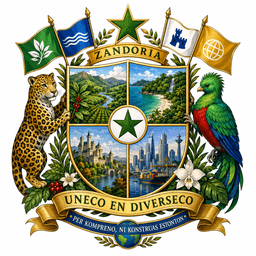
Zandoria Day fell six months ago, and the Republic marked its thirty-first year with the usual ceremonies: the President's address, the Assembly in recess, the regional capitals flying the federal flag. But we suspect few citizens paused to reflect on the single choice that made the Republic possible at all—the decision, in 1994, to adopt Esperanto as the language of federal law and federal deliberation.
The choice was radical. The four regions spoke Spanish, English, Scandinavian languages, and East Asian languages respectively. No region spoke Esperanto natively. No region had a historical claim to it. Yet the Convention's drafters understood that to choose any natural language as the federal tongue would be to elevate one region's voice above the others, and to do so would poison the federation from its founding. Esperanto was the only language in the room that belonged to no one—and therefore to everyone. It was a language of principle, not of power.
Thirty-one years later, Esperanto remains the language of the Federal Assembly, the Federal Court, and the federal civil service. Every citizen who naturalizes through the Hall of Citizens must pass a modest proficiency test. The Federal Translation Centre in Meridian and its twelve overseas annexes employ translators in all five working languages. The system works. Laws are debated in Esperanto and translated into regional working languages; citizens read them in their own tongues; the underlying legal text is always the Esperanto, neutral and shared.
Yet we wonder if the polity has fully grasped what this achievement costs and what it preserves. The cost is real: a citizen must learn Esperanto to participate fully in federal life. The preservation is equally real: no region has been able to claim that federal institutions favor its language, its culture, or its political weight. This is not a small thing. Federal systems built on a dominant language tend toward the subordination of minority regions. Ours tends, instead, toward an equality so profound that it sometimes goes unnoticed.
As the Suffrage Question and the Youth Charter move toward resolution, we urge the Assembly to remember that Esperanto is not merely a technical choice. It is the Republic's founding commitment to the principle that unity and diversity are not opposites, but partners. The language that unites us is a language that belongs to none of us alone.